
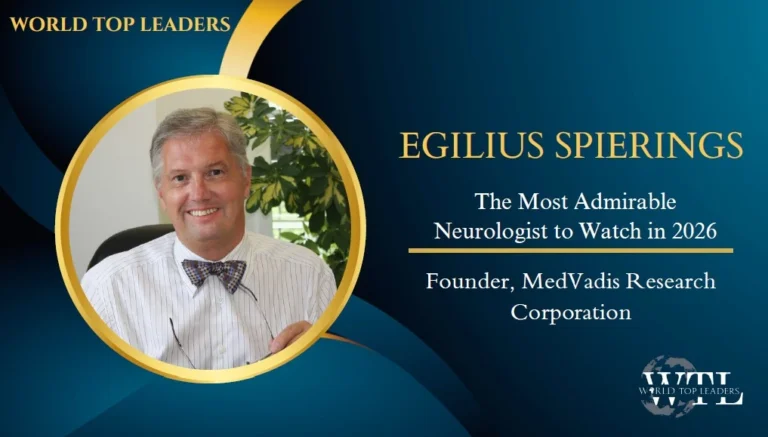
Egilius Spierings
The Most Admirable Neurologist to Watch in 2026
Dr. Egilius L.H. Spierings: Making Headache Science Understandable Through Research, Medicine, and Education
A Career Dedicated to Understanding Headache Disorders
For nearly five decades, Dr. Egilius L.H. Spierings has devoted his professional life to understanding one of the most common yet often misunderstood health conditions: headaches. As a physician, neurologist, pharmacologist, researcher, and educator, he has worked across clinical practice, academic medicine, and clinical research to improve the understanding and treatment of headache and face pain disorders. His work reflects a consistent interest in finding better answers for patients while helping healthcare professionals understand the science behind these conditions.
At MedVadis Research Corporation, Dr. Spierings continues to contribute to medical research through clinical studies and the development of better treatment approaches. He began his academic journey at Erasmus University in Rotterdam, the Netherlands, where he earned his medical degree and PhD in experimental pharmacology. He later completed postgraduate training in neurology, neurosurgery, psychiatry, and headache management, building a strong foundation in the study of pain and neurological conditions. His career subsequently included academic appointments at Harvard Medical School and Tufts University, where he taught and contributed to the development of medical knowledge.
However, his work has never been limited to academic research or clinical practice alone. He has also focused on making medical information accessible to people who experience headaches but may not fully understand their causes or treatment options. This commitment is reflected in his 2025 book, HEADACHES: Why You Have Them – What You Can Do About Them, published by Fulton Books. Drawing on decades of experience, the book connects medical science with practical information that patients and healthcare professionals can use to better understand headache disorders.
Connecting Clinical Experience with Research
Dr. Spierings’ approach to medicine is shaped by the close relationship between patient care and scientific investigation. His experience treating thousands of patients has given him a detailed understanding of how headache disorders can affect people differently and how their symptoms may change over time. At the same time, his background in pharmacology and clinical research allows him to examine these conditions through the mechanisms that cause pain and the treatments designed to manage it.
At MedVadis Research Corporation, he serves as Founder, Medical Director, and Principal Investigator, contributing to the organization’s work in advancing treatments for medical conditions. The research team brings together physicians, investigators, nurses, and clinical research professionals, supporting the work involved in conducting medical studies. His role connects scientific investigation with the practical needs of patients and the wider medical community.
For Dr. Spierings, understanding a condition requires looking beyond its most visible symptoms. Headaches may be influenced by several factors, including sleep, fatigue, nutrition, hormonal changes, physical strain, and other health conditions. His work encourages a broader examination of these influences rather than treating every headache as an isolated problem. This approach also recognizes the importance of accurate diagnosis, since different headache disorders can require different forms of treatment.
Advancing the Understanding of Headache Disorders
One of the important aspects of Dr. Spierings’ work is his contribution to the scientific understanding of headache and facial pain. His research has addressed migraine, cluster headache, and other complex pain conditions. He has also contributed to the understanding of specific headache syndromes and treatment approaches, including the use of indomethacin for hemicrania continua and high-dose verapamil for cluster headache.
His research career has included more than 300 scientific publications and participation in clinical studies examining treatment options for headache disorders. Such work reflects the importance of continued investigation in a field where patients may experience different symptoms, treatment responses, and levels of disability.
Clinical research also plays an important role in examining whether potential treatments are effective and safe. Through MedVadis Research, Dr. Spierings has remained involved in clinical trial work, helping connect scientific questions with evidence that can inform medical practice. His work on migraine treatment has included research into newer therapeutic approaches, alongside established medication options.
Rather than viewing innovation only in terms of new medicines, his work also highlights the value of improving how existing medical knowledge is understood and applied. Better explanations of symptoms, diagnosis, medication use, and prevention can make an important difference to patients navigating a complicated health condition.
A Book That Brings Medical Knowledge Closer to Readers
The publication of HEADACHES: Why You Have Them – What You Can Do About Them in 2025 represents an important extension of Dr. Spierings’ work as a physician, researcher, and educator. Written for both general readers and healthcare professionals, the book addresses a subject that affects millions of people but is often surrounded by uncertainty and misconceptions.
The book begins with a concern familiar to many people who experience severe headaches: whether the pain could indicate a serious neurological condition, such as a brain tumor. It explains how physicians assess headache symptoms and when diagnostic procedures such as CT scans or MRI may be necessary. By presenting the reasoning behind medical evaluation, it helps readers understand why a careful clinical assessment matters.
The discussion then moves into everyday factors that can contribute to headaches, including fatigue, irregular meals, insufficient sleep, hormonal changes, and environmental influences. One important subject is the relationship between metabolic energy and muscle tension. Dr. Spierings explains how fatigue can contribute to persistent tightness in the neck, shoulders, and jaw, which may play a role in frequently occurring headaches.
Migraine receives particular attention. The book examines its genetic basis, varied symptoms, and effects on the body, including nausea, vomiting, and sensitivity to light and sound. It also explores the biological mechanisms behind headache pain and the development of scientific understanding over time.
Its treatment chapters cover established medications such as ergots and triptans, as well as newer therapies including gepants and CGRP antibodies. Prevention is another major theme, with attention to sleep, diet, stress management, and other lifestyle factors. The book also considers health conditions associated with chronic migraine, including anxiety, depression, gastrointestinal problems, and sleep disturbances. Beyond migraine, it discusses cluster headache, concussion-related headaches, trigeminal neuralgia, and temporomandibular disorders.
By bringing these subjects together, Dr. Spierings offers readers a broader understanding of headache disorders and the different factors that may influence their development and management.
Education as an Important Part of Better Patient Care
For Dr. Spierings, education is closely connected to effective healthcare. Patients who understand their symptoms and the reasons behind their treatment are better prepared to take part in decisions about their care. This is particularly important for headache disorders, which can be recurring, complex, and disruptive to everyday life.
His years in academic medicine allowed him to share his knowledge with medical students, healthcare professionals, and fellow researchers. His teaching experience at Harvard Medical School and Tufts University helped extend his work beyond individual patient consultations. Through scientific publications, books, clinical research, and professional education, he has continued to contribute to the exchange of knowledge within the medical community.
His book carries this educational purpose to a wider audience. It does not focus only on describing different types of headaches. It also explains how physicians approach diagnosis, why treatments differ, and how prevention becomes part of long-term management. This combination of scientific detail and practical guidance makes the subject more approachable without losing its medical depth.
Looking Ahead: Better Understanding, Better Treatment
As research into headache disorders continues, Dr. Spierings’ work remains centered on improving the understanding of their causes and identifying effective ways to manage them. Clinical studies, developments in pharmacology, and a better understanding of the relationship between neurological conditions and overall health all contribute to this effort.
Through MedVadis Research Corporation, his continued involvement in clinical investigation supports the search for treatment options that can address the needs of patients. His work also reinforces the importance of examining the wider health factors that may accompany chronic headache conditions. A single treatment approach may not be suitable for everyone, making careful diagnosis and an understanding of individual circumstances essential.
His contribution also extends to the way headache medicine is communicated. By explaining complex medical concepts in accessible language, he helps bridge the gap between scientific knowledge and everyday life. His book is an example of this effort, bringing together nearly fifty years of research and patient care experience in a resource intended for both patients and healthcare professionals.
A Lasting Contribution to Headache Medicine
Headache disorders can affect work, family life, sleep, and a person’s ability to participate in everyday activities. Yet many people continue to struggle with uncertainty about why their headaches occur and what can be done to manage them. Dr. Egilius L.H. Spierings has spent much of his career addressing this gap through clinical practice, research, teaching, and medical writing.
His work brings together the responsibilities of a physician who treats patients, a researcher who investigates the science of disease, and an educator who makes that knowledge easier to understand. Through MedVadis Research Corporation and his 2025 publication, he continues to support a more informed approach to headache care.
Ultimately, his professional contribution lies not only in advancing medical research but also in helping people make sense of a condition that affects millions. By connecting scientific understanding with practical guidance, Dr. Spierings continues to make headache medicine more accessible to the people who need it.