
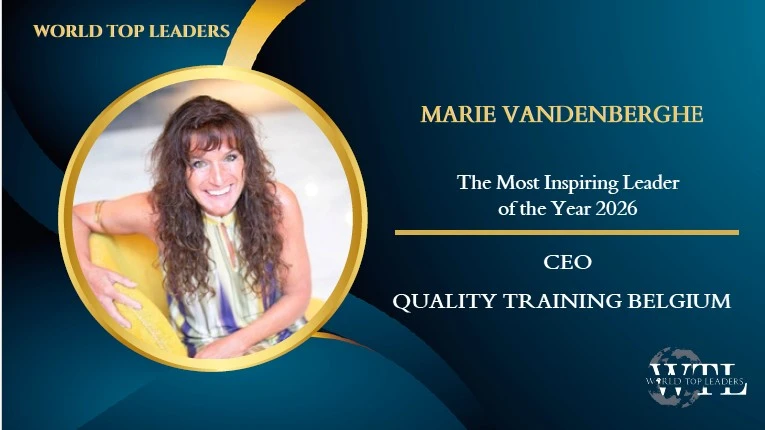
Marie Vandenberghe
The Most Inspiring Leader of the Year 2026
Marie Vandenberghe: Building Better Organisations Through Human-Centred Learning
Leadership is often measured through growth, performance, and results. Yet, behind every successful organisation are people who are willing to learn, adapt, collaborate, and grow. For Marie Vandenberghe, CEO of Quality Training Belgium, this human element has always been at the centre of leadership.
Her professional journey began as a trainer before progressing into the role of Training Manager within a multinational company. Working closely with employees, managers, and HR teams gave her a first-hand understanding of the influence that effective learning can have on individuals and organisations. She saw how the right learning experience could improve not only professional performance but also confidence, motivation, and a person’s understanding of their own capabilities.
A defining moment came in 2008, when she founded Quality Training with a clear purpose. She wanted to create an organisation built around humanity, agility, and active listening, while delivering learning experiences that were practical, tailored, and capable of producing measurable results.
Today, as technology and Artificial Intelligence continue to reshape workplaces, Marie remains focused on a balanced approach. Rather than treating technology as a threat, she views it as an opportunity to rethink learning while placing greater value on skills that remain deeply human.
Leading Through Trust and Empowerment
Marie describes her leadership style as human-centred, collaborative, and purpose-driven. Her approach is not based on having every answer. Instead, she focuses on creating an environment where talented people can contribute, take initiative, and continue developing their abilities.
Trust, respect, and open communication form the foundation of this culture. Over time, her leadership has also evolved significantly. In the early stages of Quality Training, she was highly involved in operations and personally delivered many training programmes. As the organisation grew, she recognised that effective leadership required a shift from doing everything herself to empowering others.
That evolution has become one of the most rewarding parts of her leadership journey. Seeing trainers, project managers, and partners succeed together now represents a major source of satisfaction.
Her inspiration comes not from one particular leader, but from people who combine strategic vision with genuine humility. She admires leaders who listen, serve others, and help people reach their full potential.
Calm Decisions in Times of Change
For Marie, strong leadership becomes particularly important during periods of uncertainty. Her approach to high-stakes decisions begins with listening. She considers the perspectives of clients and team members while also examining the realities of the situation.
Rather than allowing fear or emotion to determine a decision, she believes effective choices should bring together data, experience, and human judgment.
The COVID crisis and the rapid rise of Artificial Intelligence have reinforced this philosophy. Both periods required organisations to respond quickly without losing sight of their core values. Quality Training chose to remain agile, develop its learning portfolio, and help clients navigate transformation rather than resist it.
Marie also believes that motivation is closely connected to purpose. People perform at their best when they understand why their work matters and feel trusted to contribute.
Her philosophy can be summed up in her belief that excellence should become “a shared ambition rather than an obligation.”
Making Innovation Meaningful
Innovation is central to Marie’s vision, but she does not view innovation as the simple adoption of something new. For her, innovation has value only when it addresses genuine challenges and creates meaningful results for people and organisations.
At Quality Training, staying relevant involves maintaining regular dialogue with clients, observing changes in the workplace, continuously developing trainers, and embracing emerging technologies such as Artificial Intelligence.
This approach reflects a wider belief that technological progress and human development should move together.
AI can improve productivity and transform how organisations operate, but Marie points to creativity, empathy, ethical judgment, communication, and leadership as qualities that remain distinctly human. The future, in her view, will favour organisations that know how to bring technological capability and human intelligence together.
Navigating the Leadership Challenges Ahead
The modern business environment presents leaders with several pressures at once. Technological acceleration, economic uncertainty, talent shortages, and increasing expectations around wellbeing and sustainability are changing the responsibilities of leadership.
For Marie, one of the biggest challenges is helping people deal with constant change without losing their engagement, confidence, or sense of purpose.
Her answer is continuous learning. Leaders themselves must remain curious and willing to adapt, while organisations need to make learning part of everyday work rather than treating it as an occasional activity.
She also highlights the importance of balance. Organisations that focus heavily on digital transformation can risk overlooking the people responsible for making that transformation successful. The strongest organisations will therefore be those that combine innovation with empathy, performance with wellbeing, and ambition with responsibility.
A Future Built Around Human Potential
Looking ahead, Marie’s vision extends beyond the growth of a training organisation. She wants learning to be recognised as a force capable of unlocking human potential.
Her advice to aspiring leaders is direct: never stop listening. That means listening to clients as their needs evolve, listening to teams because valuable ideas often emerge from those closest to the work, and listening to oneself because authentic leadership requires self-awareness.
For Marie, leadership is not about being the most knowledgeable person in the room. It is about helping others become better than they believed they could be.
That philosophy also shapes the legacy she hopes to create. She envisions a future where learning is valued not simply as a business function, but as a means of helping people and organisations reach their full potential.
If Quality Training can contribute to organisations becoming more innovative, more human, and more respectful, while also supporting meaningful humanitarian initiatives beyond business, Marie believes that would represent a legacy worth building.
The Impact of Learning-Led Leadership
Marie Vandenberghe’s journey demonstrates how leadership can evolve without losing its original purpose. From her early experience as a trainer to her role as CEO, her focus has remained closely connected to people and learning.
Her story also offers a timely perspective on the future of work. As technology changes how organisations operate, the value of human qualities becomes even more important. Learning, empathy, adaptability, communication, and thoughtful leadership will continue to shape how successfully organisations respond to change.
For Marie, the real measure of leadership is not simply what an organisation achieves, but how many people it helps grow along the way. Through Quality Training Belgium, she continues to turn that belief into a practical leadership philosophy, one that places human potential at the heart of organisational progress.